
I’ve been thinking a lot lately about what it actually means to accelerate a mission, versus just growing a company.
Tala exists to enable financial access for the global majority. That’s been true since day one, and ten years in, it’s still the only metric I really care about. But a few years into building this, I noticed something I hadn’t examined closely: I was holding onto an assumption that wasn’t actually part of the mission. The assumption was that our relationship with borrowers had to live inside our app, under our brand.
That made sense in the early days. You need your own product to prove a model works. But the product is not the mission. The mission is access. And once I separated the two, the question changed from “how do we get more people to use Tala” to “how do we get our credit engine in front of more people, period”… regardless of whose app they’re standing in when they need it.
That’s the thinking behind embedded credit for us. We take everything we’ve built over ten years—tens of millions of loans across emerging markets, underwriting models tuned market by market, risk infrastructure, servicing, our own balance sheet—and make it available inside other people’s products. For wallets, fintechs, and other platforms that already have distribution and trusted relationships with their customers but lack a credit stack of their own, Tala enables them to bring liquidity to those customers without having to build and operate a lending business themselves.
The problem we’re solving for partners
Building lending in-house is a brutally hard, expensive, high-risk path. Credit is a discipline. It’s not a “feature” you bolt on. Underwriting, fraud, compliance, capital, collections, and servicing, all take years to get right and real money to get wrong. It takes living through multiple cycles—watching what you thought you knew get stress-tested by a currency shock, a pandemic, a political transition—and coming out the other side with your models intact and your borrowers still trusting you. Most platforms that try to add credit either stall out, or end up starting with collateralized lending because it’s the only thing they can underwrite safely with limited data and no track record. That’s a much smaller and less useful product than uncollateralized credit.
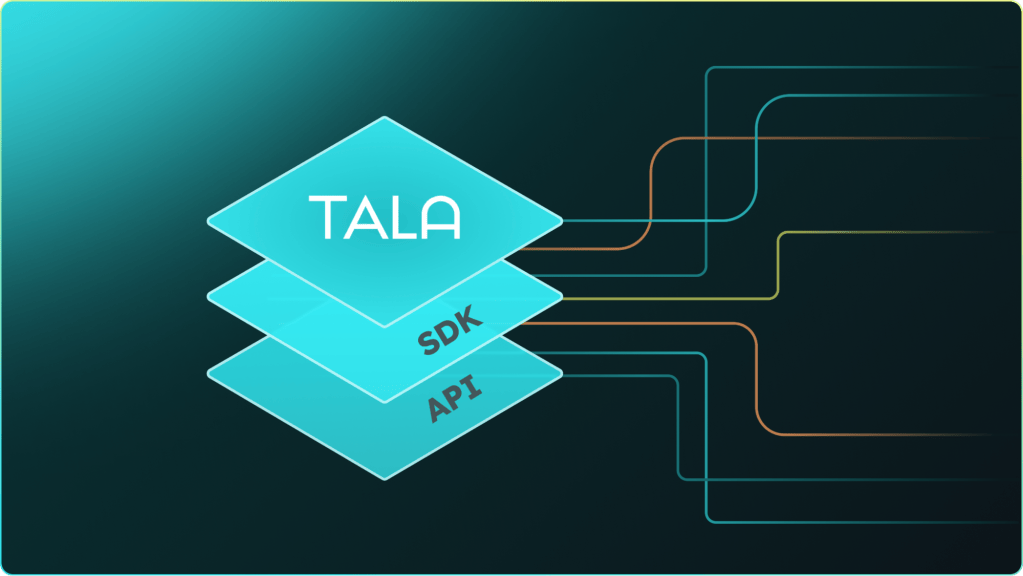
Partners shouldn’t have to build that product from scratch. We built our credit stack in the real world, market by market, cycle by cycle. Now partners can plug into it—one SDK, the full stack, live in days.
I want to walk through the model itself, because I think the structure is what makes this interesting, not just the concept.
How the model works
- A single SDK that abstracts the stack. Partners integrate once, and get the full credit lifecycle (underwriting, risk decisioning, servicing, compliance) without having to build or staff any of it themselves.
- We bring our own liquidity and take the credit risk. Partners aren’t underwriting anything or holding risk on their balance sheet. We do.
- We share the revenue. Partners get a new revenue line that’s high-retention, since credit deepens a user’s relationship with whatever product they got it through, without absorbing any of the risk or operational load that normally comes with it.
I think about this model as a shift in how infrastructure platforms align with partners—sharing revenue generously with the wallets and platforms that bring distribution, and removing as much integration friction as possible. It’s a model that works because it aligns incentives cleanly: we want partners to have a real, durable reason to keep offering this, not just a one-time integration.
We have already gone live with multiple wallet and payment providers across the ecosystem who have turned on this new feature.
What makes me most excited about this model is the flywheel it creates. Every partner that plugs in reaches users we could never reach alone. Every new user deepens the dataset. Every loan cycle makes the models sharper. The mission scales in a way that we never could have scaled with the app alone.
Still working through a lot of this in real time, but wanted to share the thinking as it stands. One thing I know for sure: Access shouldn’t be something people have to come find. It should already be there, waiting for them. That’s what a better, more equitable financial system looks like.
Originally published by Shivani Siroya on Linkedin